
GA, UNITED STATES, August 11, 2026 /EINPresswire.com/ — A multifunctional frequency modulated continuous wave (FMCW) LiDAR capable of high-precision ranging and multi-parameter sensing is proposed for the first time. By detecting the echo signals from both free space and optical fiber, 3D imaging and the measurements of diverse physical parameters, including environmental temperature, gas concentrations and liquid density can be measured simultaneously. The proposed multifunctional LiDAR exhibits significant application potential in fields such as new energy vehicles and spacecraft.
With the rapid development of new energy vehicles and automatic driving technologies, the requirements for vehicle perception systems are becoming increasingly stringent. Although traditional FMCW LiDAR offers high-precision 3D imaging capabilities, its functionality is limited and cannot detect internal battery states or environmental parameters. Meanwhile, thermal runaway in batteries poses a significant safety risk for electric vehicles, with early warning relying on the coordinated monitoring of multiple parameters such as temperature, electrolyte density, and characteristic gases. Currently, these functions are typically achieved by separate imaging and sensing systems, leading to high system complexity, elevated costs, and significant integration challenges. Therefore, developing a multifunctional LiDAR system that combines high-precision imaging with multi-parameter environmental sensing has become an urgent need to advance the safety of automatic driving.
In a new paper published in Light: Advanced Manufacturing, a team of scientists, led by Professor Yongkang Dong from National Key Laboratory of Laser Spatial Information, Harbin Institute of Technology, China, Zhengzhou Research Institute, Harbin Institute of Technology, China, and co-workers have developed a multifunctional FMCW LiDAR capable of high-precision ranging and multi-parameter sensing for the first time. By detecting the echo signals from both free space and optical fiber, 3D imaging and the measurements of diverse physical parameters, including environmental temperature, gas concentrations and liquid density can be measured simultaneously. In the experiment, a target at 30 m was imaged with an adjustable resolution spanning 0.3 cm to 1.2 cm. Meanwhile, the electrolyte density and temperature of a battery were measured with accuracies of 3×10⁻⁵ g/mL and 0.5 °C, respectively. The concentrations of gases (C2H2, CO2 and CH4), which are critical for monitoring thermal runaway of a battery, were measured with detection limits of 0.07 ppm, 48 ppm, and 0.56 ppm, respectively. The proposed multifunctional LiDAR exhibits significant application potential in fields such as new energy vehicles and spacecraft.
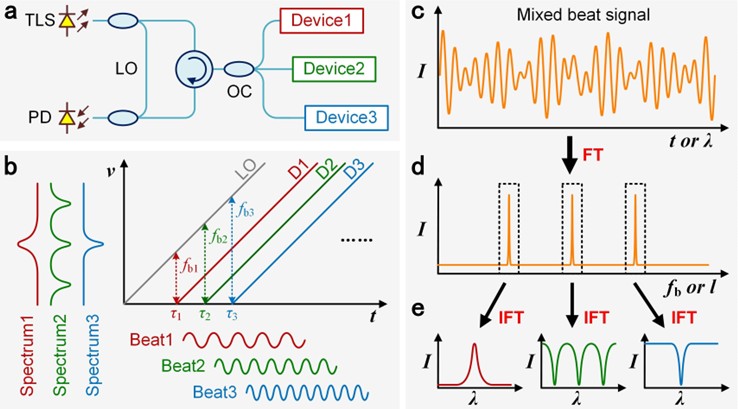
By moving the FMCW LiDAR technology from free space into the optical fibers, an optical frequency domain reflectometry (OFDR) is realized, which can be used in sensing. Similar to FMCW, the OFDR also uses a linearly modulated continuous light source for optical fiber measurement, and their positioning principle is the same. It has unique advantages of high spatial resolution and large dynamic range, and has been enabled in the sensing of various measurands including strain, temperature, pressure, and gas concentration. These scientists summarize the operational principle of their camera:
“A multifunctional FMCW LiDAR system is proposed for the first time, which has ability of 3D imaging of objects in free space and sensing of multi-parameter simultaneously. In concept-proof experiments, the imaging of a plastic plate with a “HIT” symbol placed 30-m away is realized. Sulfuric acid solution is used as candidates for monitoring various aspects such as temperature, electrolyte density. And three mixed gases (C2H2, CO2 and CH4) are filled in a multi-pass cell (MPC) for the monitoring of gas leakage.”
“In the LiDAR module, the distance of the target can be calculated from the optical path difference between the collimator reflection peak and the target reflection peak. The reflection spectra in wavelength domain of the FBG, FP and MPC can be demodulated respectively from their reflection peaks in spatial domain by IFT.
“The presented technique can simultaneously realize the key functions of automatic driving system and battery management of the new energy vehicle with only one demodulator. It holds widespread application potential in the field of new energy vehicles, which is expected to provide a new integrated solution to improve the safety of new energy vehicles. ” the scientists forecast.
References
DOI
10.37188/lam.2026.102
Original Source URL
https://doi.org/10.37188/lam.2026.102
Funding information
This work was supported by the National Key Research and Development Program of China (No. 2023YFF0715804, No. 2022YFB3207602), the National Natural Science Foundation of China (No. 624B2053, No. 62205297), the Postdoctoral Scientific Research Development Fund of Heilongjiang Province (No. LBH-Q21092), and the National Key Laboratory of Laser Spatial Information Foundation (No. LSI2024WDZC003).
Lucy Wang
BioDesign Research
email us here
Legal Disclaimer:
EIN Presswire provides this news content “as is” without warranty of any kind. We do not accept any responsibility or liability
for the accuracy, content, images, videos, licenses, completeness, legality, or reliability of the information contained in this
article. If you have any complaints or copyright issues related to this article, kindly contact the author above.

Media gallery