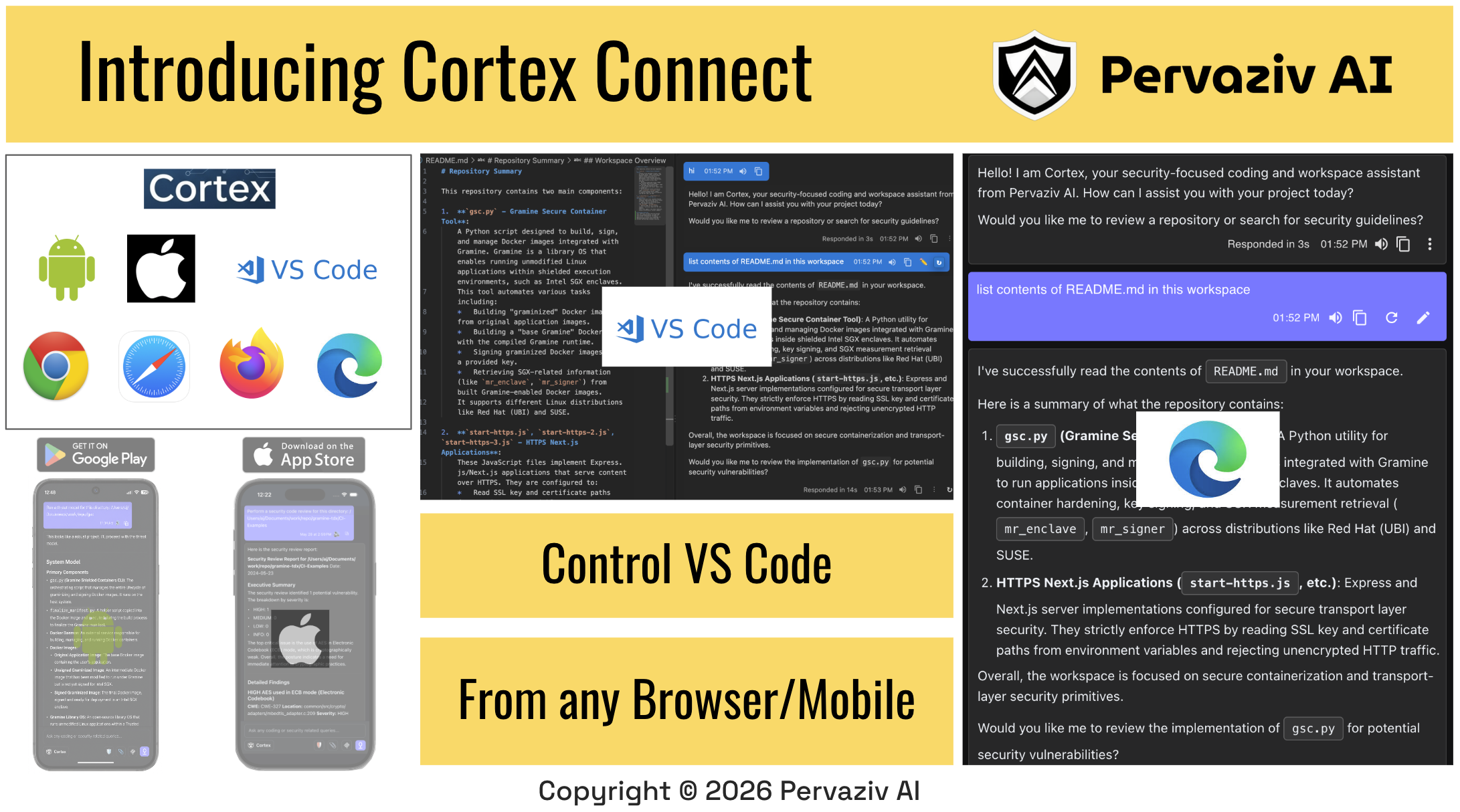

Cortex Connect links user intent, workflow progress and workspace execution across devices, turning AI conversations into governed outcomes where code lives.
SAN FRANCISCO, CA, UNITED STATES, August 25, 2026 /EINPresswire.com/ — Pervaziv AI today announced Cortex Connect, a major expansion of its Cortex Enterprise AI platform that enables users to begin work from mobile or browser and securely continue that work in a connected Visual Studio Code workspace.
Cortex Connect is designed around a simple reality: modern software work does not happen on one screen. A question may surface while reviewing a report in a browser. A security concern may appear while a user is away from a desk. An engineering objective may begin on mobile. But when that request becomes real development work, the relevant code, tools, project context, permissions and review process often live in the development workspace.
Cortex Connect bridges those moments.
Rather than forcing users to manually move prompts, context and progress between separate interfaces, Cortex Connect creates continuity across mobile, browser and Visual Studio Code. Users can express an objective where the need appears, maintain visibility as the workflow progresses, and connect that intent to the trusted workspace where project aware execution can occur within user controlled boundaries.
The launch follows Pervaziv AI’s rapid expansion of the Cortex AI Model Ensemble. The company introduced the Ensemble to coordinate specialized intelligence across privacy, prompt protection, security analysis, safety, coding, validation and related software workflows. Cortex Router added intelligent routing based on user intent and task requirements. Cortex Planner, announced as the ninth specialized model, added structured planning that turns broad objectives into organized stages for implementation, testing, security review, integration and validation.
Cortex Connect extends that progression from intelligence and planning into connected execution.
“Enterprise AI should not make people choose between access and context,” said Anoop Jaishankar, Founder and CEO of Pervaziv AI. “The best place to recognize a need is not always the best place to complete the work. Cortex Connect allows intent to begin wherever the user is, while execution remains grounded where the code, tools, permissions and project context actually live. That changes AI from something tied to a screen into a connected layer that can move with the user while preserving visibility and control.”
Jaishankar continued, “The next competitive advantage in Enterprise AI is continuity: moving from an idea to a plan to governed execution without rebuilding context every time users change devices or work surfaces. Cortex Connect brings that continuity into the Cortex architecture and creates a more direct path from human intent to trusted outcomes.”
## Enterprise AI Should Move With the Work
————————————————————
Most AI assistants still assume the place where a request begins is the place where every part of the interaction will continue. Real enterprise work is more fluid.
Developers move between code, documentation, issue trackers, browser research, meetings and mobile devices. Engineering leaders may need visibility into work while away from a workstation. Security professionals may identify a concern while reviewing enterprise context and want it investigated inside the connected codebase. A developer may initiate a task on one surface, review progress on another and return to Visual Studio Code when deeper project inspection is required.
In each case, the user should not become the integration layer.
Copying prompts between applications, reconstructing context, reopening old threads and manually explaining what already happened creates friction and introduces opportunities for intent to be lost. It also makes longer running AI work harder to understand because progress is scattered across separate conversations and interfaces.
Cortex Connect is designed to replace that fragmented experience with continuity of intent, continuity of progress and continuity of control.
The important question is no longer which device owns the conversation. The more useful question is where the work can be completed with the right context, tools, permissions and human oversight.
Cortex Connect gives users a consistent way to engage Cortex across mobile, browser and Visual Studio Code while keeping development work grounded in the connected workspace.
## From Specialized Intelligence to Connected Execution
—————————————————————————-
Pervaziv AI built the Cortex AI Model Ensemble around the idea that different AI responsibilities require different forms of intelligence.
Privacy awareness, prompt protection, security analysis, safety decisions, coding, patch validation, routing and planning are not identical problems. They require different context, evaluation criteria and levels of control.
The Ensemble coordinates these capabilities so the appropriate intelligence can contribute at the appropriate point in a workflow.
Cortex Connect applies the same philosophy to work surfaces. Just as one model should not perform every responsibility, one interface should not be expected to serve every moment of work.
Mobile is useful for access, awareness and responsiveness. The browser is central to research, documentation, enterprise applications and operational context. Visual Studio Code provides the development environment where developers can work directly with code, project structure and development tools.
Cortex Connect brings those strengths together without requiring one surface to imitate another.
A phone does not need to become a miniature desktop IDE. A browser does not need to recreate a developer’s entire environment. Instead, each surface contributes what it does best while Cortex maintains a coordinated experience across them.
## Two Stages Create One Connected Experience
——————————————————————
Cortex Connect brings together two foundational stages that address different parts of the problem. The first is durable workflow continuity.
Enterprise AI tasks increasingly extend beyond one prompt and one response. A meaningful request may require understanding an objective, reviewing available context, organizing work, coordinating specialized capabilities, waiting for user input, applying approvals, tracking progress and validating results.
Users should be able to move away from a screen, switch devices or return later without losing sight of that work.
Cortex Connect is designed to preserve a consistent view of workflow progress across connected Cortex experiences. Requests, meaningful workflow stages, decisions and outcomes can remain part of a more coherent user experience instead of being trapped inside one temporary interface.
For users, the benefit is straightforward: the work should not disappear because the screen changed.
A request started in the browser can remain visible when the user later opens Cortex on mobile. Progress associated with work in a connected Visual Studio Code workspace can remain part of the broader Cortex experience. A completed result can return to the same coordinated workflow rather than becoming an isolated response in another destination.
This continuity also creates a stronger foundation for approvals, review and user directed control. As AI takes on longer and more consequential work, enterprises need confidence that progress can be understood and that ordinary interruptions do not erase visibility.
The second stage is connected execution in Visual Studio Code. This is where continuity becomes action.
A user can express an objective from the surface that is most convenient. Cortex can interpret the request, apply relevant specialized intelligence and organize the work. When the task requires project aware execution, Cortex Connect can carry that intent to the connected Visual Studio Code workspace, where the appropriate development context is available within permitted boundaries. The workspace remains central.
Cortex Connect does not require users to duplicate their development environment somewhere else simply to continue an AI interaction. Instead, the mobile and browser experiences can connect to the development environment already being used, allowing work to proceed where the code and relevant tooling live.
## Start Where the Need Appears
———————————————-
Cortex Connect supports a more natural way to engage AI across the software lifecycle. A developer reading documentation in a browser can identify a gap and ask Cortex to prepare an update in the connected workspace. An engineering leader reviewing a feature summary on mobile can initiate a focused implementation request tied to the active project. A security professional reviewing enterprise context can identify a concern and ask Cortex to investigate the relevant portion of the connected codebase. A developer can start work away from the IDE, follow meaningful progress, then return to Visual Studio Code to inspect the resulting changes, review project context and continue working.
The pattern is consistent: start where the need appears, execute where the right context exists, and keep the experience coordinated throughout.
That is the central promise of Cortex Connect: access across work surfaces, connected execution where the code lives, and one continuous path between them.
## Intent Sharing, Not Screen Sharing
—————————————————
Cortex Connect is not designed around a remote control metaphor.
The goal is not to reproduce a desktop interface on a phone or require users to click through an IDE remotely. It is to create a higher level connection between human intent and a trusted development workspace.
The user communicates the outcome they want. Cortex helps understand the request. The Ensemble contributes specialized intelligence. Cortex Planner can organize the work. The connected workspace provides the project aware environment in which permitted actions can occur. Progress and results can then flow back through Cortex so the user can remain informed across supported work surfaces.
This approach is important because more capable AI should reduce interface friction, not increase it.
Users should be able to operate at the level of goals, decisions, approvals and outcomes rather than being forced to reproduce every low level development interaction from a smaller screen.
## Human Control Remains Central
————————————————
Connected execution does not mean unchecked execution.
Cortex Connect is designed to preserve human control as workflows become more capable. Requests remain aligned with the connected workspace, available context and permitted actions. When a workflow requires review or approval, those decisions can remain part of the user experience rather than disappearing inside opaque automation.
This gives organizations a practical path toward more agentic AI assisted development.
Users can initiate work from more places without surrendering oversight. Developers can keep project aware execution grounded in their development environment. Teams can follow progress and outcomes across Cortex. Review and approval can remain part of consequential workflows. AI can become more useful without becoming less accountable.
The goal is not autonomy for its own sake. The goal is dependable execution with people controlling the boundaries that matter.
## Why Continuity Matters as AI Becomes More Agentic
————————————————————————–
The shift toward agentic software development increases the importance of continuity because more valuable workflows are also more likely to span time, tools and decision points.
A simple question can be answered in seconds. A meaningful engineering objective may require exploration, planning, implementation, testing, review, security analysis and validation. That work may continue while a user changes locations, moves between applications or waits for another step to complete.
Without continuity, increasing AI capability can actually create more fragmentation. Users receive more outputs, more partial states and more handoffs to reconstruct.
Cortex Connect is intended to make increasing capability easier to use by keeping the user oriented around one objective rather than a collection of disconnected sessions. The system can preserve the relationship between what was requested, what is happening in the connected workspace, what decisions remain, and what outcome is ultimately produced.
That matters for enterprise adoption because trust is shaped not only by model intelligence, but by whether users can understand the state of work and intervene when necessary.
## One Cortex Experience Across Mobile, Browser and VS Code
————————————————————————————
Pervaziv AI has steadily expanded the places where Cortex can support modern engineering work.
Cortex operates in Visual Studio Code close to code and development tools. Browser experiences bring AI into research, documentation, enterprise applications and operational context. Mobile experiences extend access and awareness beyond the workstation.
Cortex Connect turns those surfaces from separate destinations into parts of one coordinated experience.
A conversation can begin on one surface and continue on another. A request can originate away from the development environment while remaining connected to it. Progress can remain visible without requiring users to stay anchored to one open interface. Results can return through the Cortex experience where users naturally engage with AI.
For individual developers, that can reduce friction. For engineering and security teams, it can improve continuity and visibility. For enterprises, it creates a stronger foundation for AI that can operate across the real shape of work while maintaining appropriate control.
## From Answers to Outcomes
——————————————
The evolution of Cortex reflects a broader change in Enterprise AI.
Early AI assistants focused on producing answers. Coding assistants brought AI closer to implementation. The Cortex AI Model Ensemble introduced specialized intelligence for the responsibilities surrounding secure software delivery. Cortex Router helped determine where work should go. Cortex Planner added structure to what should happen next.
Cortex Connect adds the next step by linking coordinated intelligence and structured planning with the workspace where an outcome can be completed.
The resulting path is increasingly cohesive.
A user expresses intent. Cortex understands the request. The Ensemble contributes specialized intelligence. Cortex Planner organizes the work. Cortex Connect reaches the trusted development workspace. The user follows progress and remains in control across mobile, browser and Visual Studio Code.
The result is not merely another AI response. It is a connected path from idea to action.
## A Stronger Enterprise AI Control Layer
——————————————————-
Cortex Connect also advances Pervaziv AI’s broader vision for Cortex as an Enterprise AI Control Layer.
Enterprise work is distributed across devices, applications, teams and moments of attention. AI must adapt to that reality without losing the context, security and governance required for meaningful action.
Users should not need to remember where a conversation started. They should not have to manually transport context between a browser, a phone and an IDE. They should not lose visibility because they stepped away from a desk. And they should not have to choose between convenient access and a development environment grounded in the actual project.
Cortex Connect is designed to remove those compromises.
It combines durable workflow continuity with connected, workspace aware execution. It extends the value of the Cortex AI Model Ensemble beyond specialized reasoning and planning into the flow of work itself. And it strengthens a platform direction in which Enterprise AI is available across work surfaces, specialized where precision matters, dependable across longer workflows and governed when action matters.
Cortex Connect represents the next step toward Enterprise AI that moves with the user, stays connected to the work and helps turn intent into trusted outcomes across mobile, browser and Visual Studio Code.
## About Pervaziv AI
—————————-
Pervaziv AI develops Enterprise AI and cybersecurity technology for modern software teams. Its Cortex platform brings together AI assisted development, software security, privacy aware workflows, prompt protection, specialized AI models, validation, enterprise connections and agentic engineering capabilities across developer, browser and mobile experiences.
The company’s broader mission is to help organizations adopt increasingly capable AI while maintaining the security, governance, visibility and human control required for real enterprise use.
Pervaziv AI
Pervaziv AI
email us here
Visit us on social media:
LinkedIn
Instagram
YouTube
X
Other
Legal Disclaimer:
EIN Presswire provides this news content “as is” without warranty of any kind. We do not accept any responsibility or liability
for the accuracy, content, images, videos, licenses, completeness, legality, or reliability of the information contained in this
article. If you have any complaints or copyright issues related to this article, kindly contact the author above.

Media gallery